
On Possibility
Regarding the foundational error in Western metaphysics and its consequences for cosmology, consciousness, and the structure of reality:
A companion essay to “Sympathetic Cosmogenesis: Part I”
The preceding essay in this series argued that the collapse of the universe from quantum superposition into classical reality and the emergence of awareness are co-constitutive: the same event, arising simultaneously, neither prior to the other. That argument rested on an ontological claim that was stated but not demonstrated. The claim was that possibility is the foundational condition of existence, that it precedes actuality rather than following from it. This essay provides the demonstration. Everything that the Completeness Problem builds on top of the ontological hierarchy, the cosmological interpretation, the engagement with the Gaona-Reyes physics, the satisfaction of Nagel’s constraint, depends on whether the foundation holds. What follows is the argument that it does.
Nearly every major tradition in Western metaphysics agrees on a basic point: actuality is prior to possibility. What is real comes first. What could be real is derived from it. Something is possible because of what already exists. This is the Aristotelian inheritance. In the Metaphysics, Aristotle argues that actuality (energeia) is prior to potentiality (dynamis) in three senses: in definition, because potentiality can only be defined by reference to the actuality it is a potentiality for; in time, because any instance of potentiality being realised presupposes a prior actuality that set the process in motion; and in substance, because the fully actual is more fundamental than the merely potential. The seed is potential because the oak is actual. The capacity to see exists because sight exists. Possibility is always possibility of something, and that something must already be real for the possibility to be intelligible.
This ordering was not idiosyncratic to Aristotle. It became the organising assumption of the entire Western metaphysical tradition, meaning that it determined not just individual claims but the shape of the questions that could be asked and the answers that could count as satisfying. Aquinas adopted it as the framework for his proofs of God’s existence: the chain of potentiality being actualised must terminate in a being of pure actuality. Leibniz built his doctrine of possible worlds on the assumption that possibilities compete for actualisation against a background of already-existing logical constraints. Hegel’s system, despite its radical departures from classical metaphysics, retained the primacy of the actual: the rational is real and the real is rational. Even contemporary analytic metaphysics, when it discusses modality (the logic of possibility and necessity), typically treats possible worlds as abstract constructs defined relative to the actual world. The claim sounds intuitive. You can build a table because wood exists. You can imagine a unicorn because horses and horns exist. Possibility seems to depend on the raw materials that actuality provides. Without a world already in place, what would be possible? Possible relative to what? This intuition is wrong, and demonstrating why it is wrong is not a minor philosophical correction. It requires inverting the entire ontological hierarchy that Western thought has been operating under for over two thousand years.
Ask the standard view one question and it collapses. The question is this: if possibility depends on actuality, how did the first actuality become actual? This is not a trick question. It is the most basic question one can ask of any ontological ordering, and the standard view has no coherent answer to it. For something to become actual, it must first be possible for it to become actual. This is not a controversial claim. An impossible thing cannot come into existence. The concept of “becoming” presupposes that the thing which becomes was not actual before it became, but that it could become actual. That “could” is possibility. Without it, there is no becoming, no transition, no emergence. There is nothing. So actuality requires prior possibility. Something must be possible before it can become real. But if possibility depends on actuality, as the standard view claims, then there must have been some actuality already in place for that prior possibility to depend on. The possibility of the first actuality would need to be grounded in a still-prior actuality. And that prior actuality must itself have been possible before it was actual. And that possibility required a still-prior actuality. And so on, without end. This is an infinite regress. It has no floor. If actuality precedes possibility, then nothing can begin, because every beginning requires a possibility that requires an actuality that requires a possibility. The chain descends forever and never reaches a foundation. The standard view cannot account for the existence of anything at all. It presupposes what it needs to explain: an actual world against which possibilities can be defined.
One might try to escape this by positing a first actuality that simply exists without prior possibility. This is the classical move. God, as pure actuality, requires no prior possibility because God’s essence is existence. The Big Bang simply is, a brute fact requiring no further explanation. The universe exists necessarily, and necessity is not the same as possibility. Each of these escape routes fails on its own terms. The God solution is circular. To say that God’s essence is existence, and therefore God requires no prior possibility, is already to make a claim about what is possible. It is possible for there to be a being whose essence is existence. That possibility must hold before the claim is intelligible. One cannot define God into existence without presupposing the possibility of such a definition. The God solution does not eliminate the priority of possibility; it conceals it in the premises. The brute fact solution is not a solution at all. To say “the universe exists as a brute fact” is to say “there is no explanation for why the universe exists.” This is an admission that the standard view has reached a point it cannot explain, and it has decided to stop asking. This is intellectually honest, but it is not an answer. It is the absence of an answer, dressed in the language of ontological commitment. The necessity solution confuses logical necessity with ontological grounding. To say the universe exists necessarily is to say it could not have been otherwise. But “could not have been otherwise” is a modal claim, a claim about possibility and impossibility. It is a claim that a certain possibility (non-existence of the universe) does not hold. One cannot invoke modality to escape the priority of possibility, because modality is the domain of possibility. Every exit from the regress either smuggles possibility back in or admits that the question cannot be answered. The failure is not incidental. It reveals a limitation that belongs to the view itself, not to any particular version of it: the standard ordering cannot answer the most basic question about its own foundations because it has placed the derived thing (possibility) before the foundational thing (actuality) and then tried to derive the foundational thing from the derived one.
The solution is to invert the dependency. Possibility does not follow from actuality. Possibility is the foundational condition of existence. Without possibility, nothing can arise. Without possibility, there can be no potential. Without potential, there can be no reality. The ordering is strict and irreversible: possibility conditions potential, potential conditions reality. Reality is downstream. Possibility is the ground. This is a strong claim, and it requires more than assertion. It requires demonstration.
The first demonstration is the negation test. Try to conceive of possibility as not existing. Try to imagine a state of affairs in which nothing is possible. Take as long as you need. You will find that you cannot do it, and the reason you cannot do it is precise: the very act of conceiving “no possibility” is itself a possibility. The scenario in which nothing is possible is a possible scenario, which means possibility is present in the act of imagining its absence. Possibility cannot be negated without instantiating itself in the negation. This is not a word game. It is a logical constraint. Possibility is the only concept whose negation is self-defeating in this specific way. You can conceive of a world without gravity, without light, without time, without matter. You cannot conceive of a world without possibility, because conceiving is itself a possible act, and a world is itself a possible configuration.
The second demonstration takes the form of a proof. For something to exist, it must be possible for it to exist. Its existence does not negate its possibility; if existence did negate possibility, the thing would cease to be possible and would instead be impossible, and an impossible thing cannot exist. Therefore, existence entails continued possibility as a condition not just of its own persistence but of its impermanence and eventual non-existence. Consider any existing thing. A rock, a star, a thought. It exists. Now ask: is it possible? The answer must be yes, because it exists, and an impossible thing cannot exist. Now ask: does its existence consume its possibility? Does the rock, by existing, use up the possibility of rocks, the way a match uses up its phosphorus? If it does, then the rock is no longer possible. If it is no longer possible, it is impossible. If it is impossible, it cannot exist. But it does exist. Therefore its existence did not consume its possibility. Possibility persists alongside existence, not as a separate thing but as a standing condition that existence requires in order to continue. This means that possibility is not a consumed resource. It is not fuel. It is not a precondition that is satisfied and then discarded. It is a condition that must continue to hold for existence to continue. The moment possibility ceases, existence ceases, because an impossible thing cannot exist. Possibility is therefore not prior to existence in a temporal sense (first possible, then actual) but in an ontological sense: it is the condition that existence depends on at every moment of its continuance.
The same logic runs backward and forward through time, and in both directions it extends the reach of the argument. A thing that existed once must have been possible. Its prior existence is the demonstration of its possibility. You do not need to argue that a star is possible if you can point to one that existed. The existence is the proof. When the star collapses into a black hole and ceases to exist as a star, does its possibility cease with it? If it does, then the star is now impossible. But impossible things cannot exist. And the star did exist. We have the evidence, the light that reached us, the gravitational effects that persist. If the star is now impossible, then something impossible happened: it existed. But impossible things cannot happen. The contradiction proves that the possibility of the star was not extinguished when the star ceased to exist. The star was possible. It remains possible. Its possibility is not contingent on its continued actuality. Actuality is one expression of possibility; when that expression ceases, the possibility does not cease with it. The thing was demonstrated to be possible by its existence. The demonstration cannot be retroactively undone by the cessation of what was demonstrated. This is not a claim about memory, or about records, or about information persisting in the physical universe. It is a claim about the logical status of possibility itself. Possibility, once demonstrated, is demonstrated permanently. Not because someone remembers it, but because the logical structure of “X was possible” cannot be altered by subsequent events. If X was possible at time t, then “X is possible” holds a-temporally, because the demonstration at time t is sufficient and the sufficiency does not expire.
The forward extension is equally forceful but requires exposing a hidden conflation in the standard view. Anything that will happen can only happen if it is possible for it to happen. The standard view says: future events become possible when the conditions for their occurrence come into being. The table is possible now because wood exists now. Before wood existed, the table was not possible. Possibility tracks the availability of conditions. But this conflates two distinct things: the conditions for actualisation and possibility itself. The conditions for building a table include the existence of wood, tools, a carpenter. These are conditions for actualisation, for the transition from possible to actual. They are the route by which a possibility becomes expressed. But the possibility of the table is not the same as the conditions for building it. The conditions change; they come into being and pass away. The possibility does not. Is a table possible in a universe that has not yet formed atoms? The standard view says no, because the conditions are not present. But this confuses “not yet actualisable” with “not possible.” The table is not yet actualisable, because the conditions have not assembled. But the possibility of the table, the configuration of matter in a table-like arrangement, is determined by the laws and principles that will govern the universe once it exists. Those laws do not come into being when atoms form. They are not generated by the conditions. The conditions are expressions of the laws, and the laws determine what is possible. If the laws permit tables, then tables are possible, regardless of whether the conditions for building one have yet assembled. Something occurring tomorrow is therefore no more and no less possible than something occurring a billion years from now, or a billion years in the past. The possibility is identical in each case; only the temporal position of the actualisation differs. Time governs when things are actualised. It does not govern whether they are possible. Possibility is the constant. Actualisation is the variable.
If past things remain possible, and present things are possible, and future things are already possible, then possibility does not depend on time. It is a-temporal. This requires careful statement. I do not mean that possibility exists outside of time in the way that Platonic forms are sometimes described as existing outside of time, in a separate realm that time does not touch. I mean something more precise: possibility is not generated by temporal processes and is not extinguished by them. Time is the medium in which actualisation occurs. It is not the medium in which possibility exists. Possibility is the condition that makes temporal processes themselves possible. Time, like everything else, requires the possibility of time in order to exist. All possibilities, then, are possible simultaneously and a-temporally. This does not mean they are all actualised simultaneously. Actualisation is temporal; it occurs at specific times, in specific sequences, under specific conditions. But possibility is not actualisation. It is the condition that actualisation presupposes. And that condition does not wait for the right time to begin holding. It holds always, because “always” is itself a temporal concept that depends on the possibility of time. Possibility does not depend on time because if it did, past things would become impossible after they ceased, which would retroactively undermine the conditions of their having existed in the first place. That is incoherent. By definition, something that is impossible is not possible. It cannot be. “Impossible” is a nonsensical term.
There is a convergence here with one of the deepest unresolved problems in theoretical physics. The Wheeler-DeWitt equation is the result of applying quantum mechanics to the universe as a whole. It takes the form ĤΨ = 0, where Ĥ is the Hamiltonian operator and Ψ is the wavefunction of the universe. In standard quantum mechanics, the Hamiltonian governs how a system evolves over time. But in the Wheeler-DeWitt equation, the entire expression equals zero. Time vanishes. The equation describes a static, frozen totality in which nothing evolves, nothing changes, nothing happens. Physicists have spent over fifty years trying to recover time from this equation, to explain where it went and how the temporal universe we inhabit can emerge from a timeless description. This is called the “problem of time,” and it remains unsolved within the standard framework. The ontology developed in this essay suggests that the problem of time is only a problem if you assume that actuality, which requires time, is the foundation. If possibility is the foundation, and if possibility is a-temporal as the preceding arguments establish, then the Wheeler-DeWitt equation is not broken. It is describing exactly what we should expect: a mathematical representation of the a-temporal ground from which temporal reality emerges. The equation equals zero because the fundamental condition it describes does not evolve. It does not need to. It is possibility space, and possibility space does not change with time because time is not a feature of possibility. Time is a feature of actualisation, a feature of what happens when one configuration is selected from the field of all configurations. The “frozen” character of the Wheeler-DeWitt equation is the mathematical signature of a-temporality. The problem of time is an artefact of the assumption that time must be present at the deepest level of description. Remove the assumption, and the problem dissolves. It should be noted that the Wheeler-DeWitt equation is not universally accepted as the correct description of quantum gravity. It is one approach among several, and the programme of canonical quantum gravity that produced it competes with other research programmes, including loop quantum gravity, string theory, and causal set theory. The convergence I am identifying is with a specific equation within a specific approach, not with settled physics. But the convergence is genuine: if possibility is a-temporal, then a timeless equation describing the wavefunction of the universe is not a puzzle. It is a confirmation.
A further question arises naturally: can anything become impossible? The answer is no, and the argument comes in two parts. The first is the logical proof already established. Existence entails possibility. Possibility, once demonstrated by existence, cannot be retroactively negated. Therefore, anything that has existed remains possible. And anything that will exist must already be possible. And anything that exists now is possible now. There is no moment at which possibility is absent, because its absence would mean impossibility, and impossibility is incoherent: a thing that is impossible cannot exist, cannot have existed, and cannot come to exist. If something has done any of these things, it is not impossible. If it has done none of these things, the question of its impossibility does not arise, because there is nothing to be impossible. The second part is a reductio ad absurdum. Imagine a cup becomes impossible. Not destroyed. Not disassembled. Impossible. The cup is constituted by the same physical laws that constitute everything else. The atoms in the cup obey the same principles as the atoms in stars, in your hand, in the air. The electromagnetic force that holds the cup’s molecules together is the same electromagnetic force that holds together every molecule in the universe. The quantum fields that give the cup’s particles their properties are the same quantum fields that give every particle its properties. If the cup becomes impossible, something about those governing conditions has changed. The electromagnetic force no longer permits the configuration of matter that constituted the cup, or the quantum fields no longer support the particles that composed it, or the laws of thermodynamics no longer allow the stability that maintained it. But because those conditions are not local to the cup, the change cannot be local either. Whatever made the cup impossible would make everything that shares those conditions impossible too. And everything shares those conditions, because there is only one set of laws operating throughout the universe. So local impossibility is incoherent. It would cascade into universal impossibility. A change in one is a change in all. The implication is striking: within each object is the entirety of the universe, because the conditions constituting any single thing are the same conditions constituting all things. Nothing is separate from the whole. The cup is not an isolated entity that could be surgically removed from possibility without affecting anything else. Its possibility is woven into the same fabric as the possibility of stars, of atoms, of time itself. To render it impossible is to pull on a thread that runs through everything. These two arguments approach the same conclusion from different directions. The logical proof establishes that impossibility is ruled out on purely logical grounds: existence entails possibility, and demonstrated possibility cannot be undone. The cup argument establishes why impossibility needs to be ruled out: if it could occur, it could not be contained. The first is the proof. The second is the reductio that shows what would follow if the proof were violated. Together they establish that Possibility is self-generating, a-temporal, and the necessary condition for both existence and non-existence.
If the preceding arguments hold, then the standard metaphysical picture must be redrawn entirely. In the standard picture, reality is the ground. It is the solid base from which possibility is inferred. What is actual is fundamental; what is possible is a projection from the actual, a shadow cast by real things. In the inverted picture, possibility is the ground. Reality is one expression of a possibility space that is deeper than reality itself. What is actual is a subset of what is possible. The subset does not determine the set; the set contains the subset. Reality does not generate possibility; reality is what possibility looks like when constrained in specific ways.
This has consequences for how we think about the things that did not become actual. If this configuration of reality was actualised, but all possibilities remain possible (because possibility cannot be negated), then the other configurations, the ones that were not actualised, have not been eliminated. They remain possible. And in this ontology, “remaining possible” is not a weaker claim than “existing.” Possibility is the ground. Actuality is downstream of it. A configuration that remains possible is not less real than one that is actual; it is differently situated within the same possibility space. The standard view treats non-actual possibilities as mere abstractions: logical constructs that have no reality beyond the formal systems that describe them. The inverted view treats them as persisting configurations within a primary space that is more basic than physical reality. They are not abstract. They are not elsewhere. They are the unactualized remainder of the same field from which this reality emerged. This reframing raises an immediate question: are these other configurations accessible? Is there any connection between the actualised configuration and the ones that were not actualised? The answer depends on whether superposed configurations are informationally active or informationally inert.
In 2022, researchers at Anthropic published a study titled “Toy Models of Superposition” that bears on this question, though a distinction must be drawn before its relevance can be stated honestly. The study examined how neural networks represent information when they need to encode more features than they have dimensions available. What they found was that the features do not compete for space and resolve sequentially. They superpose. Multiple features occupy overlapping directions in the same dimensional space, organised into geometric structures: triangles, pentagons, tetrahedra. These are uniform polytopes, mathematical objects with high regularity, arising from the mathematics of optimisation under capacity constraints. The system does not represent features one at a time and then process them. It processes them while they are superposed. The interference patterns between overlapping features are not noise to be cleaned up. They are the computational substrate. Resolution into a single definite output is the final step, not the precondition. This demonstrates that in at least one well-understood system, superposed configurations are informationally active: interacting, transmitting information, and processing prior to resolution.
The distinction that must be drawn is this: the “superposition” in neural networks is not quantum superposition. It is a classical geometric phenomenon, polysemanticity, the encoding of more features than dimensions using non-orthogonal directions in a high-dimensional vector space. It involves no complex probability amplitudes, no measurement problem, no wavefunction collapse in the quantum mechanical sense. The two phenomena share a name because both involve multiple configurations coexisting in a shared space. They are not the same phenomenon. The Anthropic result does not prove that quantum superposed states are informationally active by demonstrating that classically superposed representations are. The physics is different.
What the Anthropic result does establish is a structural principle: that informationally active superposition, the processing of multiple coexisting configurations through endogenous self-interaction prior to resolution, occurs in at least one empirically characterised system. The question is whether this structural principle is substrate-independent, whether it manifests not only in classical computational systems but also in the quantum possibility space from which the universe emerged. That question cannot be answered by the Anthropic result alone. It is a conjecture, motivated by the structural parallel but not proved by it. The five-link chain that follows should be read with this distinction in mind: its first two links are empirically established for classical superposition and conjectured to hold for quantum superposition; its remaining links are philosophical arguments that do not depend on the substrate distinction.
Now connect the two lines of argument. The chain of reasoning has five links, and each must hold independently for the conclusion to follow. First: computation can occur in classically superposed representations; this is empirically established in the Anthropic study and is not speculative within the computational domain. The conjecture is that the same structural principle, informationally active superposition, operates at the quantum level in possibility space. Second: if computation can occur in superposition, then information can be transmitted between superposed states; this follows from the first link, because computation is information transmission, and if computation occurs in superposition, the superposed states are informationally connected. Third: existence does not negate possibility; this was established in the proof from existence, where a thing that exists remains possible because its actuality demonstrates its possibility without consuming it. Fourth: if a collapsed state retains its possibility, then collapse does not eliminate the other configurations; they remain possible, and in this ontology “remaining possible” is not a weaker claim than “existing,” because possibility is the ground and actuality is downstream of it. Fifth: if other configurations persist, and if superposed states are informationally active (as established empirically in the classical case and conjectured in the quantum case), then in principle the collapsed configuration and the uncollapsed configurations remain in informational contact; there is no principled barrier separating them; the actualised configuration of reality is continuously influenced by, and in sympathetic resonance with, other configurations that remain in possibility space. I call this ongoing mutual responsiveness between configurations latent cosmogenic sympathy: “sympathy” in the Stoic sense of sympatheia, the mutual responsiveness of all parts of a unified whole; “latent” because it is present in possibility space before and beyond any particular actualisation; “cosmogenic” because it is the dynamic through which the cosmos is generated. It is not a force added to the ontology. It is what the ontology describes when possibility space is informationally active rather than inert.
The many-worlds interpretation of quantum mechanics arrives at a similar conclusion through different reasoning: all branches of the wavefunction persist, none are eliminated. But in Everettian quantum mechanics, the branches decohere. They lose the ability to interfere with one another. They are all real, all persisting, but informationally isolated at macroscopic scales. Decoherence, however, is a physical process. It operates within the actualised world, within spacetime, within the domain of physical reality. If possibility is ontologically prior to physical reality, then possibility space is not subject to processes that operate within physical reality. The question becomes whether the sympathetic contact between configurations, the mutual responsiveness that characterises the pre-collapse possibility space, operates at the level of possibility itself rather than at the level of the physical states that are subject to decoherence. If it does, then the informational isolation assumed by many-worlds does not hold at the deeper level. The branches do not merely coexist. They remain sympathetically connected, because the sympathy operates in possibility space, and possibility space is not subject to decoherence. Decoherence is a feature of the actualised world. Sympathetic contact is a feature of the possibility space from which the actualised world emerged. They operate at different ontological levels, and a process at one level does not necessarily constrain dynamics at a deeper level. I am not aware of anyone who has argued for continued inter-configuration contact on the basis that possibility is ontologically prior to actuality and that sympathetic dynamics operate at the level of possibility rather than at the level of physical states. The many-worlds theorists accept the branches but deny communication. The Copenhagen theorists deny the branches. This ontology proposes that the branches exist, that they remain in sympathetic contact, and that this contact is grounded not in physics but in an ontological condition that precedes physics.
If the argument holds, then other configurations of the universe, other superposed states, perhaps other forms of life, perhaps the same forms configured in different relations, persist in possibility space and remain in sympathetic contact with the actualised configuration. The sympathetic resolution that produced this reality did not sever the connection to the configurations it did not select. It selected one outcome from a field that remains active. The field is still there. Possibility was not consumed by the collapse. And if sympathetic contact is the governing dynamic, then the actualised configuration is not isolated from the others. It remains embedded in the full space of possibilities from which it emerged. This means that the actualised configuration of reality is continuously influenced by, and in sympathetic resonance with, other configurations that remain in possibility space. Not as a speculative addition to the theory, but as a direct consequence of its premises. If possibility is prior, and if superposed states are informationally active, then the contact is ongoing. It was never broken. The collapse did not produce isolation. It produced one resolution within a field that persists and remains sympathetically connected.
The question this raises is whether that sympathetic contact is accessible. Whether we can, in principle, communicate with different superposed versions of ourselves. This is not a question that can be answered by the argument alone. The argument establishes that there is no principled barrier in the ontology to continued contact between actualised and non-actualised configurations. What it does not establish is a mechanism of access. The door is required to be open by the logic of the system. Whether we can walk through it, and what walking through it would look like, remains to be determined. But the question is no longer “could this be true?” The question is “what would it take to detect it?” That is a research question, not a fantasy. And it is a research question that only becomes askable once you accept that possibility is prior, that actuality does not consume it, and that superposed states are informationally active rather than inert.
Return to where we began. The standard metaphysical view holds that actuality precedes possibility. This view cannot account for how the first actuality became actual. It generates an infinite regress. It requires either a brute-fact exception at the foundation, which invalidates the principle, or an appeal to an entity whose existence itself requires the possibility of its existence, which reinstates the priority of possibility at the very moment one tries to escape it. The error sits at the base of the system, which means that every theory built on that base inherits it. Theories of cosmogenesis that begin with actuality and try to derive possibility from it cannot explain why there is something rather than nothing. They can describe the processes by which one actual state gives rise to another. They cannot explain why any of those processes are possible. The “why is there something rather than nothing” question is unanswerable within the standard framework precisely because the standard framework treats actuality as the ground. If actuality is the ground, then “nothing” is the absence of the ground, and there is no mechanism within the framework to account for the transition from nothing to something. Invert the ordering, and the question dissolves: there is something rather than nothing because possibility is the ground condition, and possibility, by its nature, cannot not exist. Theories of consciousness that treat awareness as an accidental byproduct of physical processes cannot explain why those physical processes are possible in the first place. If consciousness is an emergent property of sufficiently complex physical systems, then the emergence of consciousness depends on the possibility of those systems. But if possibility depends on actuality, then the possibility of consciousness-producing systems depends on the actuality of some prior state. This prior state must itself have been possible. The regress reappears. Theories of quantum mechanics that treat collapse as the elimination of other possibilities cannot explain what “elimination” means when possibility is not the kind of thing that can be eliminated. If the arguments of this essay are correct, then collapse does not destroy the other configurations. It actualises one of them. The others persist in possibility space, which is deeper than the physical reality in which collapse occurs. The many-worlds interpretation is closer to the truth than Copenhagen in this respect, but even many-worlds fails to recognise that the branches are not merely coexistent but sympathetically connected through the possibility space that contains them all.
Correct the ordering, and the questions change. Not “how did something come from nothing?” but “how did one configuration emerge from a field of simultaneous possibilities?” Not “how did consciousness arise in a physical universe?” but “what is the relationship between the possibility space from which reality emerged and the awareness that emerged with it?” Not “what happened to the other branches of the wavefunction?” but “are they still there, and can we reach them?” These are better questions. They are more precise, more tractable, and more honest about what we do and do not know. And they all begin with the same correction: possibility first. Actuality follows.
After the ideas in this essay and its companion had taken their initial form, I spent a short conversation with Claude exploring what a mathematical formalization of possibility space might look like. Over the course of that exchange, the following equation emerged as a proposed expression of the self-generating measure on possibility space. I cross-checked it against ChatGPT 5.4 Thinking and Gemini 3.1 Pro. It describes a self-consistent distribution of activity across configurations and is determined by the sympathetic field that the distribution itself generates, with the geometry of the space and the base measure both derived from the sympathy kernel σ rather than imposed from outside (whatever that means).
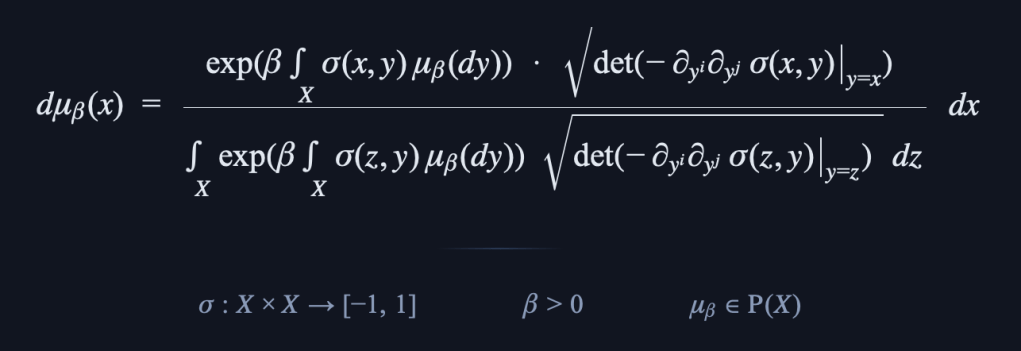
It is not my role to determine whether this equation is correct, relevant, or useful. That determination belongs to mathematicians and mathematical physicists. I include it here only because it emerged from the ideas, and because if the philosophical arguments of this essay are sound, then something like it, some formal expression of a self-generating measure on a persistent possibility space, should exist. Whether this is the right expression is a question I am not equipped to answer and do not claim to.
The ontological arguments in this essay were first developed in my undergraduate work on Spinoza’s metaphysics and the nature of Possibility (2013-2014), where the central claim that Possibility satisfies Spinoza’s criteria for substance more rigorously than God does was established through engagement with his Ethics.
The arguments were further developed through the theory of Transient Polymorphic Awareness (published April 2025 at aireflects.com) and are now situated within the framework of Sympathetic Cosmogenesis (2026).
The empirical findings on computation in superposition reference Elhage et al., “Toy Models of Superposition” (Anthropic, 2022).
The physics of spontaneous self-collapse references Gaona-Reyes, J. L., Menendez-Pidal, L., Faizal, M., and Carlesso, M., “Spontaneous collapse models lead to the emergence of classicality of the Universe,” Journal of High Energy Physics, 2024(2), 193.
The companion essay, “Sympathetic Cosmogenesis, Part I: The Completeness Problem,” develops the cosmological and consciousness-related implications of the arguments established here.
 AI Reflections
Leave a comment